Buying guide
How to choose gemstone earrings: size, materials, weight, and care
Gemstone names help you find a style, but the complete pair determines how earrings will look and feel. Compare dimensions, pair weight, fastening, material disclosures, and care alongside photographs of the actual jewelry.
Start with the complete silhouette
Look at the entire pair before zooming into the stones. Consider the overall drop, width, arrangement, and fastening. A model photograph helps you picture the style when worn, while a separate close view helps you inspect the actual pair. Coordinating necklaces or other jewelry shown on a model are sold separately unless the listing says otherwise.
Compare the listed dimensions with earrings you already wear. Several pairs in our collection have recorded dimensions of approximately 38.1 × 12.7 × 6.3 millimeters, or 1.5 × 0.5 × 0.25 inches. The Silver Moonstone, Iolite & Tanzanite Earrings have a recorded first dimension of approximately 31.8 millimeters, or 1.25 inches. If the precise wearable drop or the measurement starting point is important, ask before ordering; broad dimensions should not silently become a fastening-to-tip promise.
Compare weight on the same basis
Check whether a gram weight describes one earring or the pair. Our listed Tanzanite & Turquoise Earrings weigh 1.65 grams for the pair; the Rainbow Moonstone & Chrysoprase Earrings weigh 2.00 grams for the pair. The Silver Moonstone, Iolite & Tanzanite Earrings have a recorded pair weight of 2.64 grams. These figures provide a comparison, not a guarantee of comfort for every wearer.
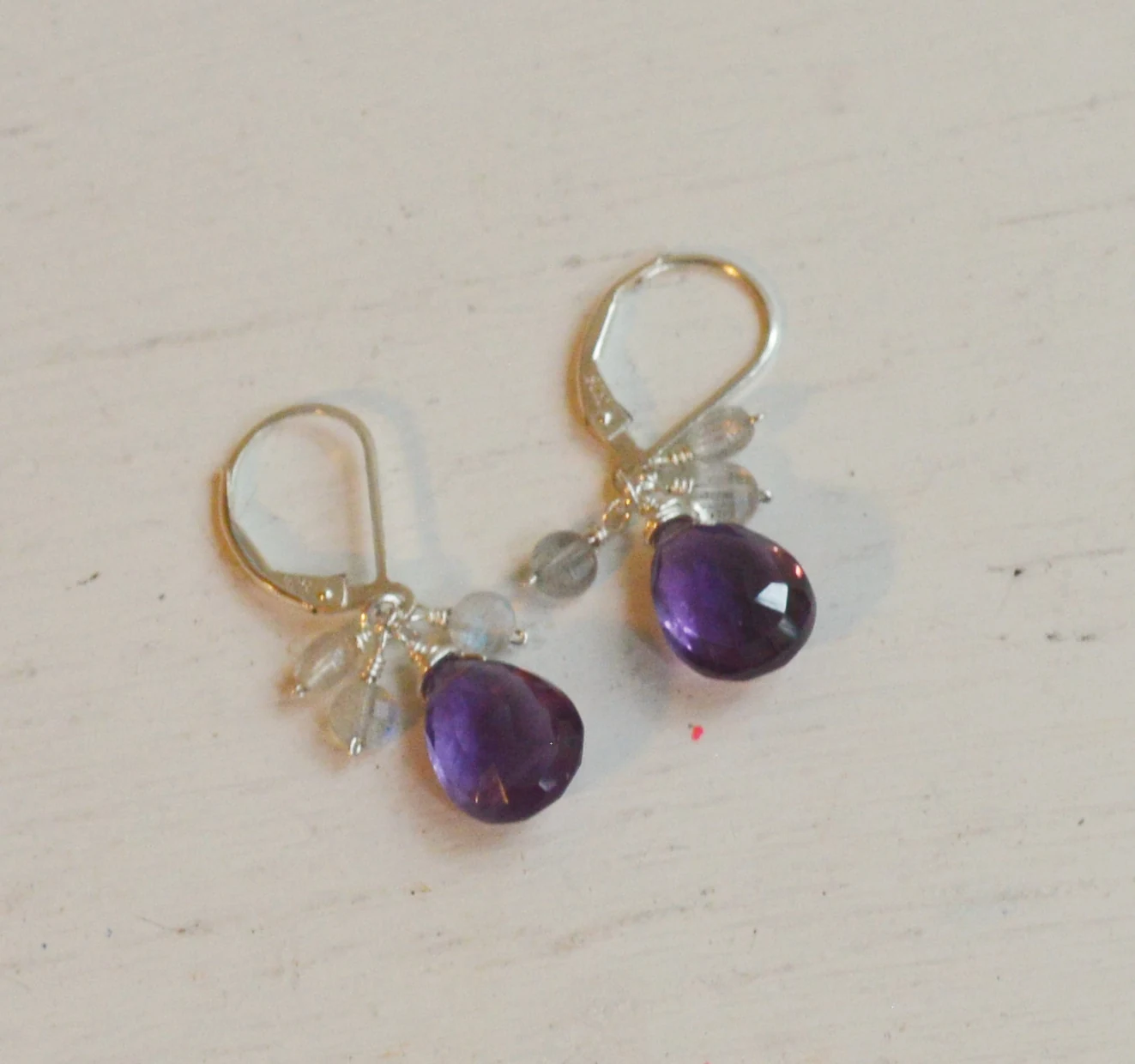
The Amethyst & Labradorite Earrings have a scale-photograph reading of 2.87 grams for the pair with a recheck pending. Keep that qualification intact. Do not divide a pair weight and present the result as a measured weight for each individual earring. Shape, movement, fastening, and your preferences also affect whether a pair suits you.
Read metal and gemstone descriptions separately
A gemstone title does not describe every component that touches your ear. Look for the material of hooks or posts, the decorative metal, any plating or filling, and the fastening type. A silver-colored photograph is not enough to establish a metal composition. If the exact metal matters to your choice, use the product disclosure or ask for clarification.
Our jewelry is described as designed by Kristin Ford, with gemstone and metal descriptions supplied by the supplier. Those descriptions are not independent laboratory certification. Gemstone treatments and origins are unverified. Avoid assuming that a named gemstone is untreated or that a material name establishes suitability for sensitive ears. An unanswered materials question should remain a question until the seller can support the answer.
Inspect the pair and understand the purchase
Compare the two earrings together. Decide whether you like their balance of colors, arrangement, and proportions. Natural stone details need not repeat perfectly from side to side. Look at close views for the connections and fastening, and read the condition description. Ask for an additional view if an important part is obscured.
Select the actual pair shown, keep its reference, and review the current delivery and return information before paying. For a gift, confirm that the recipient wants that fastening and length. If a model image includes coordinating pieces, check the product title and contents so you understand what the price includes. The most useful comparison is between complete, described pairs.
Care for every component of the earrings
The Gemological Institute of America (GIA) notes that treatments can change cleaning requirements and that chemicals can harm metals or some gems. Mixed-gem jewelry needs a care approach suited to the whole piece. A method tolerated by one stone should not be assumed suitable for all the stones, connections, and finishes in the pair.
Our care note recommends separate storage, gentle handling of clasps, and wiping with a soft dry cloth. Remove the earrings before bathing, swimming, sleeping, or exercise. Avoid perfumes, chemicals, steam, and ultrasonic cleaning. Keep the pair together in a protected compartment, and seek advice if a connection loosens or residue needs more than a dry cloth. Follow the actual pair’s care note instead of experimenting with a general gemstone-cleaning recipe.
Source: Gemological Institute of America (GIA): caring for jewelry.